
Latin and Standard
By Marina Kochetova
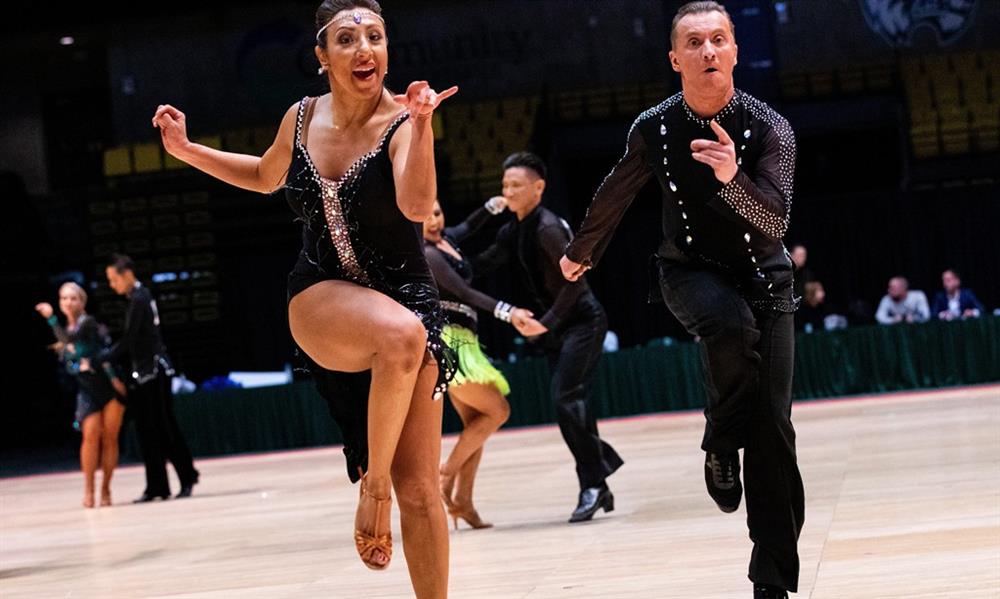
From August 26 to 30, the ballroom of the Hilton hotel at Casino du Lac-Leamy in Gatineau will host the Canadian National DanceSport Championships in various age categories. As tradition dictates, this annual event takes place there at the end of summer.
This year, the Canadian championships will be held alongside the Professional World Championships, featuring dance couples from countries around the globe. This means that even the youngest participants in the national competition will have the opportunity to see the world’s finest dancers perform in all their splendour. As the saying goes, seeing once is better than hearing a hundred times. Two major sporting and cultural events combined into one will undoubtedly attract a broad audience. Tickets are still available online, but buying them immediately before each day’s competitions will be nearly impossible. So hurry!
The international DanceSport program includes both the classical dances known as Standard—the Slow Waltz, Viennese Waltz, Tango, Foxtrot and Quickstep—and the Latin American dances: Rumba, Samba, Paso Doble, Jive and Cha-Cha-Cha. The selection of partner dances remains the same, but naturally, the technical standards rise with every competitive level.
The most prestigious achievement is winning the Ten-Dance competition, in which couples take to the floor in all ten dances, competing in both programs. Winning the Ten-Dance title is comparable to becoming the all-around champion in artistic or rhythmic gymnastics.
Gymnastics, a sport that borders on art, also awards titles in individual events: the uneven bars, balance beam, floor exercise and vault in artistic gymnastics, or the ribbon, rope, ball, clubs and hoop in rhythmic gymnastics. An athlete may lose the all-around competition yet still become a world champion in the vault, for example, or in a rhythmic gymnastics routine with the hoop.
The same is true in dancing. A couple may choose not to compete in Ten-Dance at all, specializing solely in Latin or Standard, while still winning a world title in a particular dance. Competent judges award scores to officially registered competitors, assessing their technique, rhythm, position within the partnership, line of dance and artistry.
The technical side, however, is merely a matter of facts and figures. How can anyone watch dancing—let alone dance—without becoming emotionally involved? As a rule, the more skilfully a couple conveys emotion to the judges and spectators, the higher they can expect to place. Of course, this must be combined with the precise execution of the required elements, just as in gymnastics or figure skating.
Latin American dances are especially distinguished by expressive, sensual movements filled with passion and love. The Cuban Cha-Cha-Cha, for instance, is now considered one of the defining rhythms of Latin pop music because almost any arrangement can be set to its beat, opening up boundless creative possibilities.
Paso Doble, whose Spanish name means “double step,” is so fiery that audiences practically leap from their seats when the music begins, unable to remain still. After all, the dance evokes the drama of a Spanish bullfight. That is why dramatic presentation and strict geometric lines play such an important role: without them, it is impossible to create the image of the matador.
The Samba is the Brazilian dance of life, celebration and happiness. It achieved worldwide fame and popularity largely thanks to Brazil’s unforgettable carnivals. The dance requires a unique hip action that is quite difficult to develop.
In the Standard program, the Slow Foxtrot—its English name originally referring to a “fox’s trot”—is considered the most difficult dance and the pinnacle of mastery. It requires perfect balance, continuous gliding movement, exceptionally complex coordination and complete control of the upper body, despite the relatively slow speed.
Careful control of the body is equally important in the Slow Waltz; otherwise, even the smallest mistake will be immediately noticeable and spoil the overall impression. The challenge of the Viennese Waltz lies in maintaining spatial orientation and balance while performing rapid rotations in the same direction. The Quickstep, meanwhile, requires stamina and a light, springing quality.
Not everyone can learn to dance well. At the very least, it requires perseverance and regular training. Practice must take place with a partner, because competitive ballroom dancing does not include solo programs. Unfortunately, finding compatible partners, bringing them together as a couple and teaching them to dance skilfully is no easy task.
If a couple is capable of representing their dance studio at national-level competitions, that is already a major achievement. Behind it stands not only the hard work of the dancers themselves, but also the dedication of their teachers and, to no lesser extent, their parents.
I know many children in Ottawa who have spent years training in competitive dance. One example is the Karunas family, whose three children have all devoted a great deal of time to DanceSport.
The eldest sister, Ulyana, trained in a girls’ group because she was unable to find a suitable partner. She continues to help with the musical accompaniment, managing the competition music during events organized by her studio.
The middle child, Andrei, danced for several years with a charming partner before eventually choosing to pursue sports instead.
The youngest sister, Elina, turns eleven this month. Together with her elegant partner, she is registered to compete in this year’s Canadian championships.
There are different ways to build a life: through personal toil, sweat and blisters, or by learning from the experience of others while still thinking for yourself. The second way seems to me many times more pleasant and effective. As the youngest child follows in the footsteps of her brother and sister, she learns from their experience and absorbs the best of what they have discovered.
At the same time, it is impossible to overestimate the role of parents who consistently and selflessly devote themselves to their families. My deepest respect goes to Nadezhda Karunas, the mother of these wonderful children. Without her active and wise involvement, their lives would not be nearly as rich in fascinating events and promising projects.
Experts in raising the younger generation of the twenty-first century increasingly agree that modern children and teenagers should not simply be “moulded.” Instead, they should be nurtured consciously, with favourable conditions created for their growth. It is ourselves whom we must educate and discipline.
Enrolling children in dance classes in Ottawa is an expensive undertaking. The one advantage is that most local studios are owned by Russian-speaking people, and many members of the Russian-speaking community teach and dance there. But the prices are in dollars, not rubles.
Parents must pay not only for lessons, but also for competition fees, costumes, hairstyles, travel, hotels and much more. Children who play competitive ice hockey cost their parents even more. Everyone understands that there is no such thing as a free lunch.
And yet, what a joy it is to watch the progress of young fledglings spreading their wings and gradually becoming strong, magnificent birds—if not dance champions, then certainly poised and confident people who understand that life is not made only of treats and celebrations, but also of bruises and hard-earned lessons.
Besides confidence, dancing develops posture, an elegant walk, softness of gesture, grace of movement and the ability to control one’s body. Along with flexibility and musicality, it also builds character.
Just imagine the dazzling, world-class spectacle you could witness by coming to admire the captivating variety of couples at the upcoming championships—right here, close to home! Brilliant costumes, magnificent music and the very best dancers await you. They will undertake a breathtaking marathon for your equally breathtaking enjoyment.
Do you already know which you prefer—Standard or Latin?