
Shall We Talk?
An Interview with Arkady Klyuchansky
By Marina Kochetova
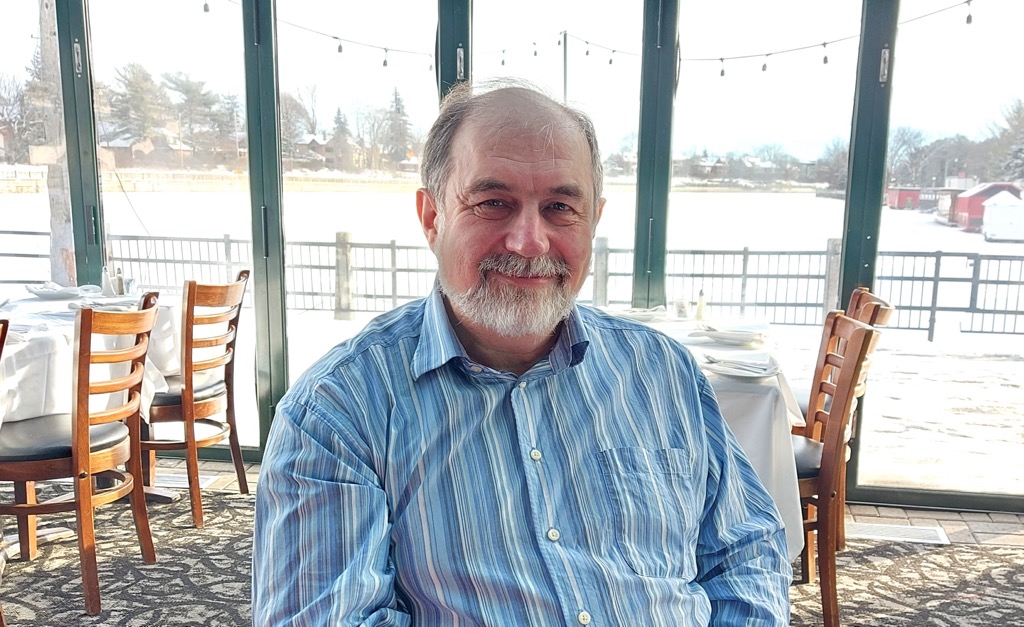
There are people with whom one can talk for hours, especially about literature, language, culture, and the human experience. One such person is Arkady Klyuchansky, a lecturer at the University of Ottawa. His life journey is unusual: from a Soviet scientific town and a chemistry institute to teaching Russian language and Slavic culture in Canada.
Childhood in Dubna and a Love of Learning
Until the age of twelve, Arkady lived in Dubna, a famous scientific city on the Volga River. The atmosphere of the town was shaped by its international nuclear research institute, making it quite different from most Soviet cities.
Surrounded by educated people and excellent teachers, he developed a passion for reading at an early age. History, adventure novels, and Russian classics became his constant companions. For many years, he dreamed of dedicating his life to history.
A Humanitarian Among Chemists
Despite his obvious interest in the humanities, Arkady first applied to the Faculty of Physics at Moscow State University. He was not admitted due to intense competition and instead enrolled at the Mendeleev Moscow Institute of Chemical Technology.
Following graduation, he worked at the Zelinsky Institute of Organic Chemistry of the USSR Academy of Sciences.
Today, he admits that he never truly felt like a chemist. Nevertheless, studying the exact sciences taught him discipline, logic, and analytical thinking. He often quotes Mikhail Lomonosov, who wrote that mathematics is worth studying because it brings order to the mind.
France: The First Emigration
In the early 1990s, while waiting for permission to immigrate to Canada, Arkady spent two years in France.
He considers this period one of the most exciting chapters of his life. Arriving with very limited French, he quickly adapted and found work in an organization promoting international educational and cultural cooperation.
It was also in France that he first began teaching Russian.
Looking back, he smiles at the memory of his first students, who trusted a teacher with little experience but great enthusiasm.
Paris helped him discover not only a new language but also a calling in education and culture.
A New Life in Canada
Arkady arrived in Canada shortly after his mother had settled there.
Like many immigrants, he had to rebuild his life from scratch. One of his first priorities was learning English. After completing ESL courses, he enrolled at the University of Ottawa.
There he studied Slavic Studies, a field he had once considered too difficult even to contemplate.
He later continued his education at the University of Toronto, where he also taught Russian as a graduate student.
Eventually, he returned to Ottawa and began teaching at the University of Ottawa, where he has remained for more than two decades.
A Career He Loves
Teaching gradually became more than a profession—it became a vocation.
Arkady believes that every good teacher must remain a lifelong learner. In his view, it is impossible to inspire students if one stops growing intellectually.
His students come from a wide variety of academic backgrounds. Contrary to popular belief, most are not future linguists. They include aspiring diplomats, economists, political scientists, and international relations specialists.
For them, language is not an end in itself but a valuable tool that broadens opportunities and deepens understanding of the world.
Advice for New Immigrants
After more than thirty years in Canada, Arkady has developed a clear perspective on successful integration.
He sees education as one of the most effective ways to adapt to a new country.
Studying not only improves language skills but also helps people understand the culture, build professional networks, and become part of the community.
He encourages newcomers to continue their education in Canada whenever possible, even if they already possess degrees and professional experience.
Local qualifications and additional training often make the transition into the Canadian workforce much smoother.
College or University?
When asked whether college or university is the better choice, Arkady avoids simple answers.
In his view, the two serve different purposes and should not be compared directly.
The right choice depends on individual goals, talents, and career aspirations.
While fields such as medicine, technology, engineering, and business remain highly востребованные, he believes financial considerations should not be the sole factor. People are most successful when they pursue work aligned with their interests and abilities.
Why Languages Matter
Arkady is convinced that learning foreign languages remains one of the most valuable skills in today's world.
Most language students do not intend to become teachers or translators. Instead, language skills provide advantages in business, diplomacy, politics, and many other fields.
Moreover, language study fosters a deeper understanding of other cultures and perspectives.
This is one reason why courses on Russian culture at the University of Ottawa often attract even more students than language classes themselves.
Online Learning and Human Connection
The pandemic forced universities around the world to move online.
While Arkady acknowledges the benefits of technology, he believes it cannot fully replace face-to-face communication.
Language is more than vocabulary and grammar. It includes tone of voice, gestures, facial expressions, eye contact, and emotional nuance.
For this reason, he jokingly describes language as a “contact sport.”
Writing can be learned through correspondence, but speaking requires interaction with real people.
Students benefit from communicating with many different speakers, each with a unique voice, rhythm, and style.
Looking Ahead
Despite rapid technological change, Arkady remains convinced that human interaction will continue to be the foundation of education.
He welcomes hybrid approaches that combine classroom instruction with online learning, but he does not believe technology can fully replace personal contact between teacher and student.
After a life that has taken him through science, immigration, and academia, he has reached a simple conclusion: never stop learning, remain open to new experiences, and do not be afraid of change.
Optimism, curiosity, and a genuine interest in people make any journey easier and more rewarding.